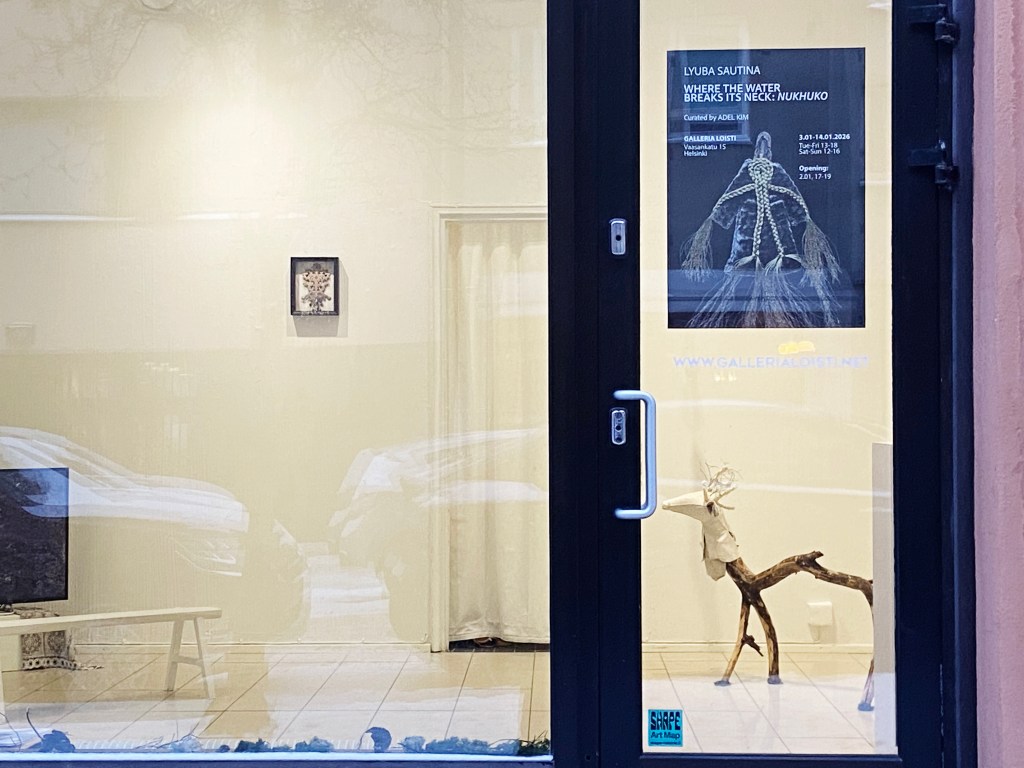
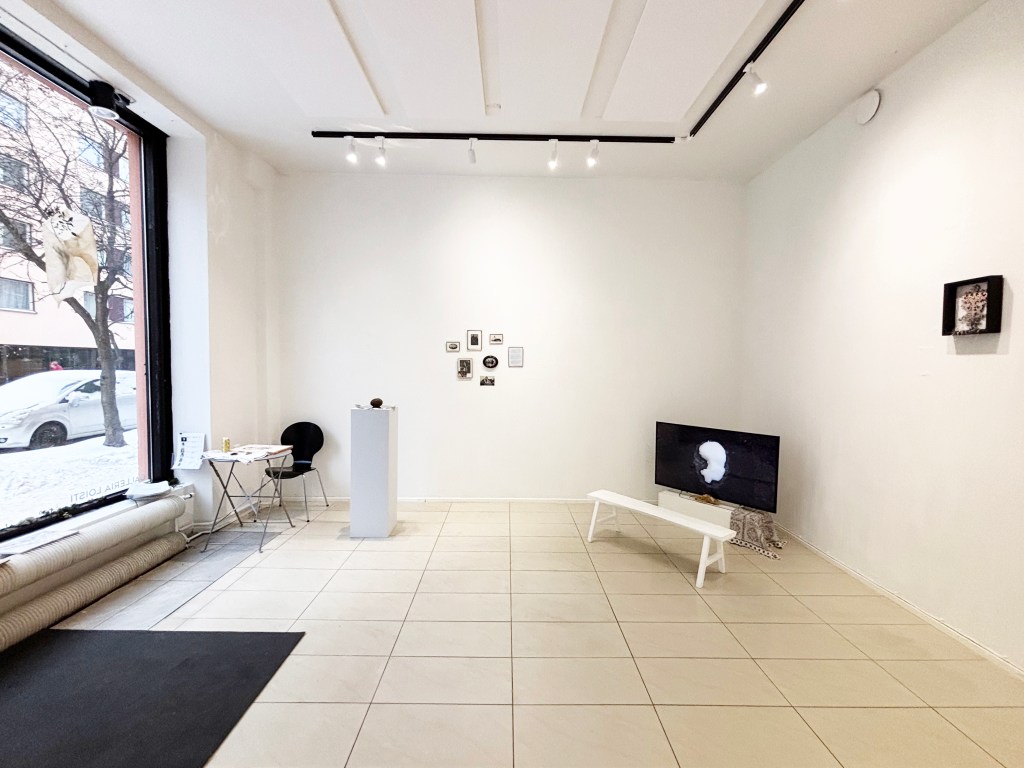
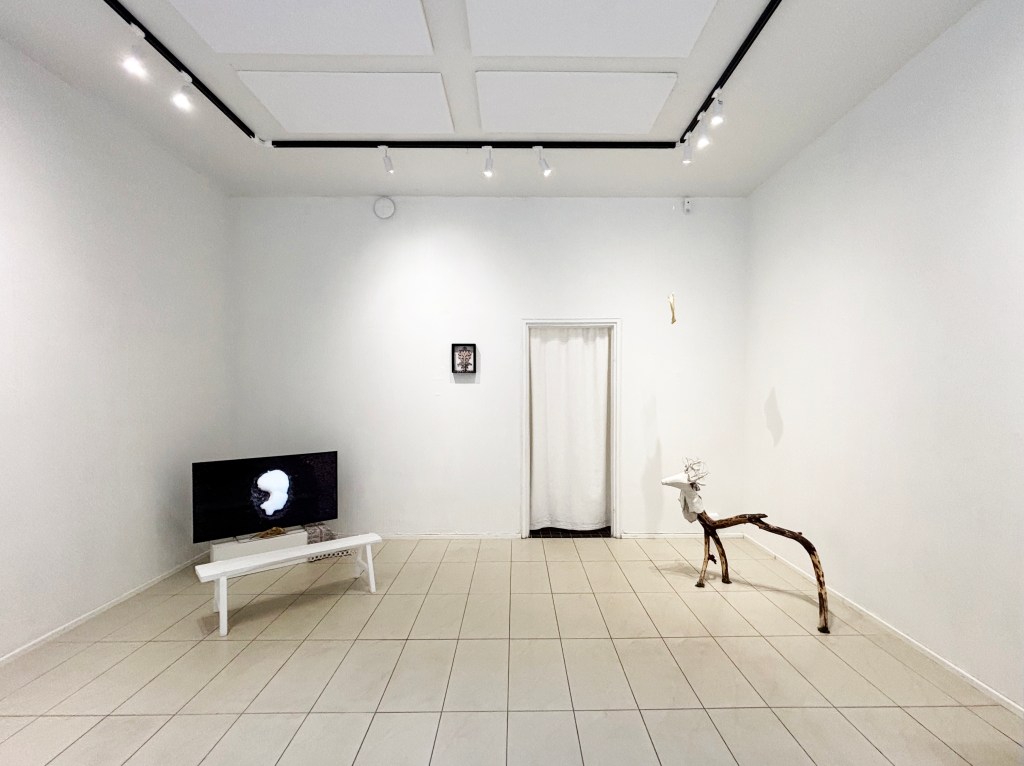
Lyuba Sautina’s first solo exhibition in Finland presents recent works that explore questions of legacy, belonging, and the rigid frameworks of national identity. Working with textile and creating mixed-media pieces from second-hand fabrics, leather, goldwork, embroidery, and found objects, Sautina translates personal experiences into material form.
Nukhuko marks the first step in the artist’s investigation of her own multiethnic identity, as she turns to her Nenets heritage. The Nenets, currently the largest of the Samodeic (Samoyedic) peoples, inhabit the northwestern regions of present-day Russia. Despite the ancestral connection, the artist has been largely deprived of Nenets culture, having neither lived in these territories nor been included in the extended family circle. This absence is compounded by a fear of exclusion from the community, as she is neither fully Nenets nor familiar with Indigenous ways of living.
To a significant extent, such circumstances are shared by many people living in present-day Russia, given its long history of migration, colonization of Indigenous territories and peoples, interethnic marriages, and the twentieth-century project of creating a unified “Soviet people.” Although Russian colonization in the modern times is often described as a form of “internal colonization,” a concept suggesting that the state colonized its own territories and treated its population, including ethnic Russians, as colonized subalterns, the process of appropriating the so-called “Russian North” in pursuit of natural resources was no less invasive or violent than other colonial histories. For example, Nenets communities faced military oppression and Christianization beginning in the sixteenth century, followed by collectivization, suppression of uprisings, and the displacement of children to boarding schools during the Soviet period. As in many similar cases, detailed family histories are often difficult to trace in archival records due to their fragmentation and, at times, poor preservation.
Although Sautina has never had full access to her Nenets family’s culture and knowledge, she approaches this heritage from a deeply personal perspective, continuing the themes of childhood and motherhood explored in her earlier works. She recalls that as a child she longed for a pair of richly decorated Nenets fur boots but never received them, unlike her close relatives. Under her circumstances, genuine belonging remained unattainable, prompting her to adopt a strategy of self-healing.
In her distinctive artistic manner, Sautina reflects on traditional Nenets dolls known as nukhuko, creating her own versions while preserving key elements, such as using a duck’s bill—collected by her father while hunting—as the doll’s head. Through these works, she reclaims the roots she was never granted, treating the Nenets legacy with care and respect and raising difficult questions of how and by whom identities are defined.
The exhibition also features other works by Sautina, including the video The Source (2020). A mask made of breast milk depicts the artist’s face slowly dissolving into the earth, a reflection on the role of mothers in a society that forced women to deprive themselves of personal needs. Other new works include Egg (2025), made from the hair of the artist’s children, a viscerally familiar symbol of beginnings, sacrifice, and new life, continuing Sautina’s subtle observations on themes of childhood, motherhood, and women’s experience.
 Adel Kim